

Digital Queue Management for SMBs: 6 Myths Debunked
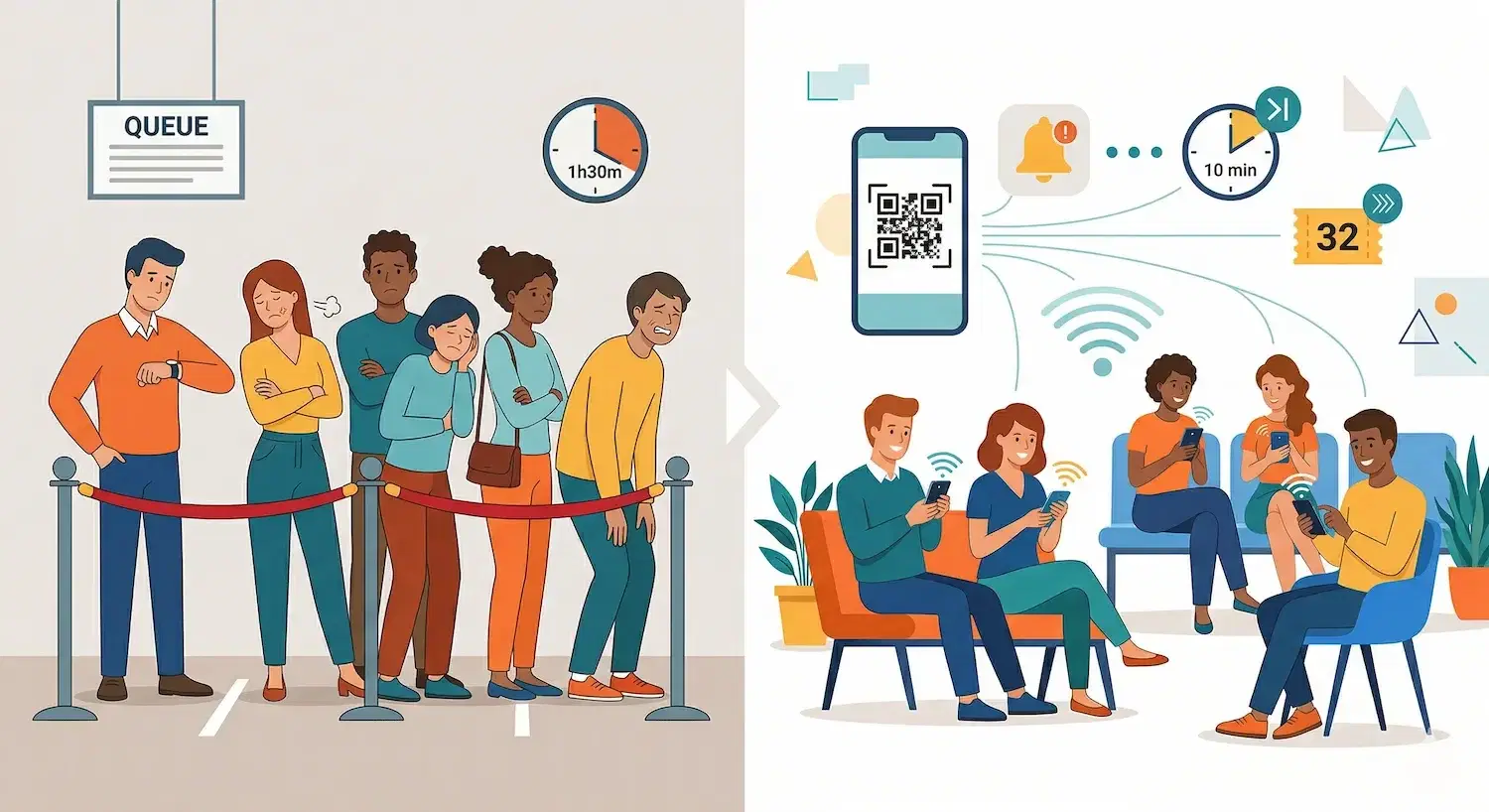
Why These Misconceptions Still Persist
Running a small business and making customers wait? That's normal. The problem is, 75% of consumers consider waiting time as the most frustrating part of their customer experience (Forrester Research). Yet many entrepreneurs remain stuck on outdated assumptions about digitalizing their queue management.
These myths persist because they tap into our deepest fears. Fear of change, fear of losing control, fear that our customers won't adapt. The result? We stick with stone-age solutions while competitors innovate.
Let's be honest: in 2024, making someone wait without giving them information is like asking your customers to play Russian roulette with their time. Not exactly a compelling value proposition, right?
In this guide, we'll demolish six persistent misconceptions about digital queue management. Spoiler alert: reality is much more accessible than you think.
Myth #1: "It's Too Complex for My Small Operation"
Reality: A modern virtual queue solution deploys in hours, not months.
Here's what actually happens. Your provider sends you a personalized QR code. You print it or display it on a tablet. Your customers scan it with their smartphone. Done. That's it.
No construction work, no wiring, no expensive kiosk installation. Virtual queue management operates entirely online. So whether you're a two-person medical practice or a 40-seat restaurant, the complexity remains the same: close to zero.
The real secret? Modern solutions like our virtual queue management solution are designed for small businesses from day one. No IT team needed. No three-week training program. Just a smartphone and internet connection.
Worried about messing up the settings? Don't panic. Most platforms offer dedicated support for small businesses. Because ultimately, you know your customer flow better than anyone.
Myth #2: "My Older Customers Won't Know How to Use QR Codes"
Reality: Seniors massively adopted smartphones during COVID, and scanning QR codes became second nature.
OK, let's talk numbers. Before 2020, this myth made sense. Today? Not really. COVID forced everyone to scan QR codes: restaurants, pharmacies, government offices. Result: even your 75-year-old grandmother knows how to point her phone at a black and white square.
But let's say part of your clientele remains hesitant. Good news: hybrid solutions exist. Your tech-savvy customers scan the code. Others register at the counter as before. You maintain flexibility.
Besides, let's be pragmatic: 82% of users prefer booking appointments online rather than queuing (DGFIP barometer). Even in government offices! So imagine in private business, where customer experience matters even more.
The bonus feature? Virtual queues often allow SMS notifications. No app to download, no need to be tech-savvy. Just receive a text with your position. Simple as that.
Myth #3: "It Will Dehumanize My Customer Service"
Reality: Eliminating waiting allows you to spend more quality time with each customer.
Here's what really happens when you digitize your queue. Your customers arrive relaxed because they know exactly when it's their turn. They haven't spent 20 minutes stressing in your waiting room. So the interaction starts on better terms.
And you? Instead of constantly managing "is it my turn soon?" and "how many people before me?" questions, you can focus on what matters: serving the person in front of you well.
Concrètement, imagine: Sarah has a physiotherapy appointment at 2:30 PM. Thanks to the virtual queue, she knows there's a 15-minute delay. Instead of sitting in the waiting room, she grabs coffee and returns at exactly the right moment. When she enters the office, she's relaxed. The therapist isn't stressed about a crowded waiting room. Everyone wins.
Digitalization enhances human interaction—it doesn't replace it. It just eliminates the painful moments for everyone.
Myth #4: "It's a Gimmick—My Customers Will Come Anyway"
Reality: A customer who waits more than 5 minutes without information is twice as likely to leave (Harvard Business Review).
Look, let's be honest: your loyal customers will probably return even if you make them wait. The problem is new customers. Those who don't know you yet and have no reason to trust you with their time.
When they see a 10-person queue with no time indication, what do they do? They leave. Silently. Without complaining. And they don't come back. Worse: they talk about it.
The numbers are brutal: long queues cause 10-15% abandonment at point of sale (Adyen study). That's revenue going straight to competitors.
By the way, in some sectors, waiting has become a selection criterion. 60% of customers choose one restaurant over another based on perceived waiting time (National Restaurant Association). In other words, managing wait times well becomes a competitive advantage.
A virtual queue transforms this weakness into strength. Instead of enduring the wait, your customers experience it as premium service.
Myth #5: "It Costs a Fortune to Implement"
Reality: Return on investment calculates in weeks, not years.
Let's talk budget. How much does a lost customer cost you? If your average basket is $60 and that customer came 4 times annually, that's $240 in lost annual revenue. Multiply by customers who leave because of waiting, and you'll see inaction costs far exceed action.
Modern digitalization solutions often work on monthly subscription. Expect $40-200 monthly depending on needs. That's cheaper than a physical kiosk (several thousand dollars). Cheaper than dedicated queue management staff. And infinitely cheaper than losing customers.
Let's calculate ROI: if your solution prevents losing just 3 customers monthly, it's already profitable. Everything else is bonus: improved customer satisfaction, reduced team stress, optimized scheduling.
Not counting indirect benefits: better brand image, positive word-of-mouth, more relaxed customers who spend more.
Myth #6: "My Competitors Aren't Doing It—Why Should I?"
Reality: That's exactly why you should do it now—to get ahead of the curve.
This argument is perfect for procrastination and terrible for business. When competitors aren't moving, that's THE moment to innovate. Not in 5 years when everyone's caught up.
Take online reservations in restaurants. Early adopters of platforms like OpenTable captured massive new customer bases. Those who waited for it to "become mainstream" now fight in a saturated market.
Concretely, imagine your customers' faces when they discover they can join your queue from their couch. Receive notification when it's almost their turn. And arrive at the perfect moment. Meanwhile at competitors, they're still standing around waiting.
Digital queue management reduces perceived waiting time by 30-50%. That's an enormous competitive advantage as long as you're the only one offering it in your sector.
The beauty? Once customers taste this fluidity, they'll struggle to return to old methods. That's loyalty through comfort.
Digital Transformation Is No Longer Optional
There you have it—we've covered the main objections. And ultimately, what do we learn? Most of our fears are unfounded. Digital queue management for small businesses isn't complicated, expensive, or dehumanizing.
It's quite the opposite: simple, profitable, and improves everyone's experience. Your customers spend less time waiting and more time enjoying your services. Your teams are less stressed. Your brand image improves.
Yes, you need to leave your comfort zone. Yes, you need to accept changing habits. But honestly, when you see the benefits, do you really have a choice?
If you want to explore this further and see concretely how it works, don't hesitate to contact us. We'd love to show you that reality often exceeds our fears.
Sources
- Forrester Research — Impact of waiting time on customer satisfaction
- Harvard Business Review — Customer behavior in extended waiting situations
- Adyen Study — Point-of-sale abandonment related to queue management
- National Restaurant Association (US) — Consumer choice criteria in dining
- DGFIP Barometer — User preferences for online services
Frequently asked questions
Related articles

Walk-in Barbershop: Digitizing Without Losing the Vibe
How can a walk-in barbershop digitize waiting without killing its spontaneous spirit? Real case study of a successful transformation.
6 min
Physical vs Digital Queues: 7 Decision-Making Criteria
Objective comparison between physical and digital queuing for local businesses: 7 essential criteria, real costs, and measured ROI.
8 min
Digital Queue Management for SMBs: 6 Myths Debunked
Complete guide to debunk misconceptions about digital queue management for SMBs. Myths vs reality with verified data and practical insights.
8 min