

Hidden Cost: When Invisible Queues Kill Your Sales
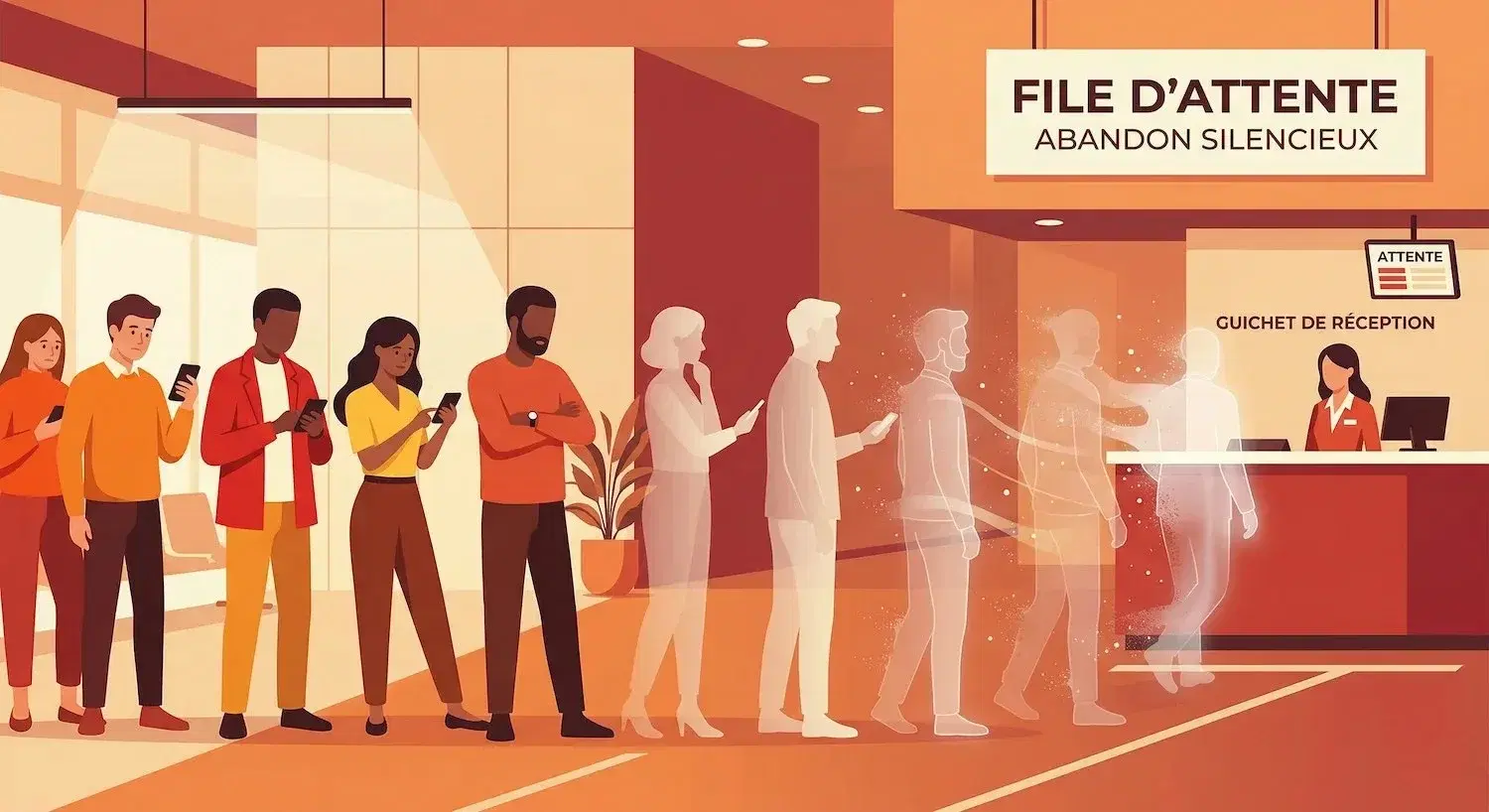
Why Invisible Waiting Threatens Your Business
Physical commerce is undergoing a silent transformation. Customers no longer oppose digital and physical experiences — they demand the best of both worlds. And in this equation, invisible waiting has become the number one enemy of commercial performance.
Unlike visible waiting (a line at your checkout), invisible waiting strikes without warning. A customer who leaves without saying anything. A last-minute cancellation. A prospect who chooses your competitor after seeing your crowd. This form of silent abandonment represents a major hidden cost for businesses because it escapes traditional performance measurement radars.
According to Forrester Research, 75% of consumers consider waiting time as the most frustrating part of the customer experience. But the real problem isn't so much the wait itself as its unpredictable and uncommunicated nature. A customer waiting without information is twice as likely to leave as an informed customer with an estimated waiting time (Harvard Business Review).
This reality affects all sectors. Restaurants where customers leave upon seeing the queue. Medical practices where patients cancel in anticipation. Retail stores that lose sales during peak hours. The challenge is no longer just operational — it becomes strategic in a context where reputation is built and destroyed in real-time on social media.
The post-COVID acceleration of digital expectations has amplified this phenomenon. Customers who learned to order online, book appointments digitally, and track deliveries in real-time now apply these standards to physical experiences. They expect transparency, control, and predictability — exactly what traditional queue management fails to provide.
Step 1: Identify Silent Abandonment Signals
The first step is to detect the invisible. Unlike customer complaints that signal a problem, silent abandonment leaves no direct trace. You must learn to read weak signals.
Analyze Your Peak Traffic Patterns
Observe moments when your traffic is at maximum capacity. These time slots are often synonymous with lost potential customers. Does a restaurant showing "full" on Saturday night lose customers who give up waiting? Does a clinic with a saturated schedule generate postponements or abandonments?
Measure the gap between your theoretical capacity and actual revenue during these peaks. If you can theoretically serve 50 customers per hour but only count 35, the missing 15 represent your opportunity cost of waiting.
Monitor Last-Minute Cancellations
Cancellations within 2 hours of the appointment or reservation are often linked to anticipated waiting. In restaurants, the no-show rate represents 5 to 20% of reservations depending on the segment (TheFork data). In medicine, this rate can climb to 30% in certain specialties.
Create a simple dashboard: cancellation rate by time slot, stated reasons (when communicated), delay between booking and cancellation. This data often reveals patterns linked to peak hours.
Track Digital Behavior Patterns
Modern customers research before visiting. Monitor your Google My Business page views, website traffic patterns, and social media engagement during peak hours. A drop in digital engagement during busy periods often signals that potential customers are being deterred by perceived wait times.
Analyze your online reviews for timing patterns. Negative reviews posted immediately after peak hours often indicate customers who left due to waiting, then vented their frustration online.
Pitfall to Avoid
Don't confuse correlation with causation. A rise in cancellations may have other causes (weather, local events, seasonality). Always cross-reference your observations with external context.
Step 2: Measure the Financial Impact of Invisible Waiting
Once signals are identified, you must quantify the lost revenue. This step transforms intuition into actionable data to justify investments.
Calculate Your Lost Revenue
Basic formula: (Number of lost customers × Average basket) × Frequency = Monthly loss
Concrete example: a hair salon loses 5 customers per day during peak hours (12pm-2pm and 5pm-7pm) due to lack of visibility on available slots. With an average basket of $45, the loss amounts to $225/day, or $4,950/month.
For appointment-based services, integrate the cost of empty slots. A doctor whose patient doesn't show up loses not only the consultation ($90) but also the opportunity to offer this slot to another patient.
Assess Impact on Customer Lifetime Value
A customer who abandons due to waiting probably won't return. According to a Journal of Service Research study, acceptable waiting time before frustration is about 2 minutes in-store. Beyond that, the risk of permanent loss increases exponentially.
Calculate: (Average customer lifetime value × Abandonment rate linked to waiting) = Long-term value loss
Include Indirect Costs
Invisible waiting generates hidden costs: time managing cancellations, lost productivity from teams managing queues, cost of acquiring new customers to compensate for departures. These elements often represent 20 to 30% of direct costs.
Consider also the stress cost on your staff. Employees dealing with frustrated customers or chaotic peak periods may experience burnout, leading to higher turnover and training costs.
Pitfall to Avoid
Don't overestimate your calculations to justify a solution. Inflated numbers lose credibility and harm your argument. Stay conservative in your estimates.
Step 3: Audit Your Customer Journey at Critical Moments
Customer journey auditing reveals friction points that generate silent abandonment. This step requires putting yourself in the customer's shoes during moments when waiting becomes problematic.
Map Moments of Truth
Identify all moments when customers might perceive waiting as excessive:
- Arrival at your premises (first impression)
- Initial contact with reception
- Waiting for actual service
- Moments of uncertainty ("How much longer?")
For each moment, note: average duration, information given to customer, alternatives offered, available signage.
Test "Mystery Customer" During Peak Hours
Have friends or colleagues from other departments test your journey during peak hours. Their mission: note their feelings, moments of discomfort, unanswered questions.
Ask them to time each step and rate their stress level on a scale of 1 to 10. A level above 6 indicates abandonment risk.
Analyze Your Wait Communication
How do you inform customers about waiting? A simple "It's busy" is no longer enough. Customers expect precise information: estimated time, position in queue, possible alternatives.
Check if your staff has tools to provide this information. Often, abandonment comes from inability to reassure customers about their wait duration.
Implement Real-Time Feedback Collection
Set up simple feedback mechanisms during the waiting process. QR codes linking to quick surveys, staff equipped with tablets for instant feedback, or even observation protocols can reveal pain points invisible from management perspective.
Customers are most honest about their experience while living it, not days later in a review.
Pitfall to Avoid
Don't conduct this audit only during off-peak hours. Problems appear during busy times. Schedule your tests during the most stressful moments.
Step 4: Measure Impact on Your Digital Reputation
Invisible waiting doesn't just lose customers — it degrades your online reputation. This step involves measuring this often underestimated impact.
Analyze Customer Reviews Related to Waiting
On Google My Business, TripAdvisor, or industry-specific platforms, search for keywords: "wait", "queue", "too long", "overwhelmed". Classify these reviews by frequency and severity.
A restaurant with 15% of reviews mentioning excessive waiting sees its average rating drop by 0.3 to 0.5 points. This drop directly impacts click-through rates on booking platforms.
Monitor Your E-Reputation in Real-Time
Set up Google alerts on your name + "wait" or "queue". Frustrated customers often express themselves on social media before leaving formal reviews.
A negative Facebook post can reach 500 people on average (author's network + shares). If 5% of these people decide not to visit you, the cost of a single negative post can represent 25 lost customers.
Calculate SEO Impact of Your Reputation
Negative reviews related to waiting impact your local SEO. Google prioritizes establishments with recent positive reviews. A 0.5-star drop can reduce your visibility by 10 to 15% on local queries.
Use tools like SEMrush or Ahrefs to track your positioning evolution on queries including your business sector + your city.
Track Social Media Sentiment
Beyond reviews, monitor social media mentions during and after your peak hours. Tools like Hootsuite or Mention can alert you to negative posts about waiting experiences at your business.
Respond quickly and professionally to social media complaints. A well-handled response can turn a detractor into an advocate and show potential customers that you care about their experience.
Pitfall to Avoid
Don't respond defensively to negative reviews about waiting. Acknowledge the problem and present your improvement actions. This approach often transforms a detractor into an ambassador.
Step 5: Build an Anti-Abandonment Action Plan
The final step transforms your observations into concrete actions. The goal isn't to eliminate waiting — that's impossible — but to make it acceptable and predictable.
Implement Proactive Communication
Inform customers BEFORE they ask. Display real-time wait times, send confirmation SMS with precise times, automatically offer alternative slots.
A virtual queue management solution transforms endured waiting into chosen waiting. Customers can leave and do something else while being notified by SMS when their turn approaches.
Develop Alternatives to Physical Waiting
Offer options: pre-ordering, click & collect, delayed appointments with discounts. The idea is to give customers control over their waiting time.
In restaurants, 60% of customers choose one restaurant over another based on perceived waiting time (National Restaurant Association). Offering an alternative can make the difference.
Train Your Teams in Wait Management
Your staff are on the front line. They must know how to:
- Estimate and communicate wait times
- Reassure without making impossible promises
- Offer alternatives
- Manage impatient customers
Well-trained staff can reduce wait-related abandonment by 30% simply through better communication.
Create Wait-Time Value
Transform waiting from a negative into a potential positive. Offer Wi-Fi, charging stations, entertainment, or educational content. Some businesses use waiting time for upselling or collecting customer preferences.
Retail stores can use queue time for personalized product recommendations. Medical practices can provide health education content. Restaurants can showcase their ingredients or preparation methods.
Pitfall to Avoid
Don't multiply technological solutions without training your teams. The best app in the world is useless if no one knows how to explain it to customers.
Expected Results and Return on Investment
Implementing these steps generates measurable results in the short and medium term. The goal isn't just to reduce abandonment — it's to transform waiting into a competitive advantage.
Immediate Benefits (1-3 months)
20 to 30% reduction in wait-related abandonment through better customer information. Decrease in negative reviews mentioning excessive waiting. Improved work atmosphere for your teams, who manage fewer frustrated customers.
Virtual queue systems reduce perceived waiting time by 30 to 50% according to Waitiii user feedback, even when actual duration remains identical.
Medium-term Benefits (6-12 months)
Revenue increase through recovery of "lost" customers. Improved average rating on review platforms (positive SEO impact). Enhanced loyalty through smoother customer experience.
Companies that master their wait management see their customer recommendation rate increase by 15 to 25% on average.
ROI Calculation
Simple formula: (Recovered revenue + Operational savings - Solution cost) / Solution cost × 100
For a business losing $2,500/month due to silent abandonment, investing $400/month in a wait management solution generates a 525% ROI from the first year.
Competitive Advantage
Businesses that solve the invisible waiting problem don't just recover lost customers — they attract customers from competitors who haven't addressed this issue. In an increasingly competitive market, superior wait management becomes a differentiator.
Invisible waiting is no longer inevitable. It becomes a differentiation lever for companies that know how to measure and master it. Contact us to discover how to transform your wait management into a competitive advantage.
Sources
- Forrester Research — study on consumer frustration related to waiting time
- Harvard Business Review — impact of information on customer waiting behavior
- Journal of Service Research — acceptable waiting time in stores before frustration
- TheFork — statistics on no-show rates in restaurants
- National Restaurant Association (US) — influence of waiting time on restaurant choice
Frequently asked questions
Related articles
5 Ways Waiting Drives Away Customers (And Your Revenue)
Discover how waiting times cause customer churn and revenue loss for small businesses. 5 concrete mechanisms + solutions to improve retention.
8 min
Wait Psychology: Why 5 Minutes Feel Like Forever
Discover why waiting creates anxiety and how transparency transforms customer experience. Perceived time vs real time explained with data.
8 min