

Wait Psychology: Why 5 Minutes Feel Like Forever
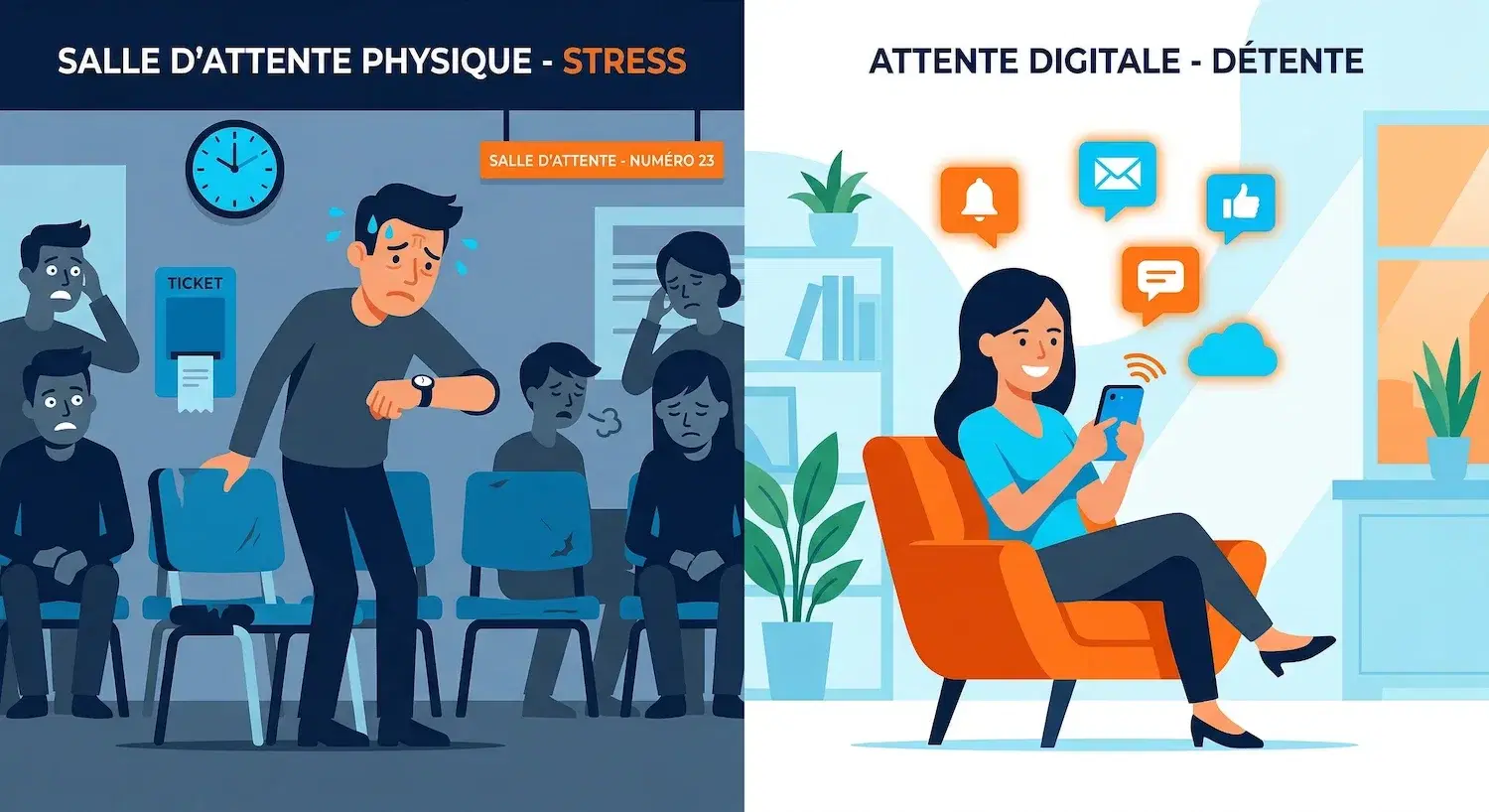
Waiting: A Psychological Plague Before a Temporal One
You're at the doctor's office. Your appointment was scheduled 10 minutes ago. You check the clock every 30 seconds. Those 10 minutes feel endless. Yet the 10 minutes you spent scrolling your phone when you arrived flew by unnoticed.
This perception difference isn't trivial. 75% of consumers consider waiting time the most frustrating part of customer experience (Forrester Research). The real issue? It's not the objective duration of waiting, but how our brain processes temporal uncertainty.
Wait psychology reveals a fascinating paradox. Anxiety generated by uncertainty can make 5 minutes feel longer than 15 minutes of informed waiting. This distortion of perceived time explains why some customers abandon after minutes of "blind" waiting, while others patiently wait half an hour when they know their position.
Actually, let's understand the psychological mechanisms at play. And compare two radically different approaches to wait management: the traditional opaque approach versus the modern transparent approach.
The Traditional Approach: Waiting in Uncertainty
The classic model - you know it well. Customers arrive, take a numbered ticket or sign a list, then wait without information. This approach generates several harmful cognitive biases documented by behavioral research.
First mechanism: temporal uncertainty effect. Without indication of wait duration, the brain enters "vigilance" mode. It constantly scans the environment to assess the situation. This hypervigilance accelerates time perception. A Journal of Service Research study shows that acceptable waiting time before frustration is about 2 minutes in retail when no information is communicated.
Second factor: opportunity anxiety. Customers wonder if they should leave and return later, or choose a competitor. This mental rumination amplifies the waiting sensation. Harvard Business Review demonstrates that a customer waiting more than 5 minutes without information is 2× more likely to leave the establishment.
Third element: occupied versus unoccupied waiting. In 1985, MIT's Richard Larson established that occupied waiting feels 36% shorter than empty waiting. Yet the traditional approach leaves customers in passive waiting, without constructive occupation. Result? Maximized negative time perception.
This approach also generates counterproductive behaviors. Customers frequently interrupting staff to know their position. Creating tense atmosphere in waiting areas. And most importantly, silent departures of frustrated customers.
The Transparent Approach: Information as Anxiolytic
The modern wait management approach relies on a simple principle: transparency reduces anxiety. By providing customers clear information about their position and estimated wait time, we radically transform their psychological perception of the situation.
The first benefit? Predictability. When customers know they have 12 minutes left, their brain can plan. Check emails, make a call, or simply relax. This planning ability, even short-term, significantly reduces cognitive stress associated with uncertainty.
Second advantage: perceived control effect. Even if customers can't accelerate the process, knowing their situation gives them a form of control. They can make informed decisions to stay or postpone their visit. This decisional autonomy improves subjective experience.
Third element: wait time optimization. With reliable estimation, customers can productively use their waiting time. Run nearby errands, grab coffee, or handle personal tasks. Waiting becomes "recovered" time rather than "lost" time.
Modern virtual queue management solutions exploit these psychological mechanisms by sending SMS or push notifications with real-time position and wait estimation. Customers stay informed effortlessly, reducing anxiety and improving overall service perception.
The measurable effect is significant: perceived wait time reduction reaches 30 to 50% with these transparent systems, even when objective duration remains identical.
Approach Comparison: Factual Analysis
| Criteria | Traditional Approach | Transparent Approach |
|---|---|---|
| Customer Information | None or minimal | Position + real-time estimated time |
| Generated Anxiety | High (uncertainty) | Low (predictability) |
| Time Utilization | Passive waiting | Optimized/productive time |
| Abandonment Rate | 10-20% after 5 min | 3-8% (continuous information) |
| Perceived Satisfaction | Duration-dependent | Transparency-dependent |
| Customer Flexibility | Limited (mandatory presence) | High (mobility possible) |
| Staff Load | Frequent interruptions | Reduced questions |
| Data Collected | Limited | Complete (behavior, peaks) |
| Implementation Cost | Low (tickets/notebook) | Moderate (digital solution) |
| Scalability | Difficult | Easy (configuration) |
This comparison reveals that investment in transparency generates measurable benefits on customer experience. Behavioral data confirms that information reduces anxiety more effectively than objective wait time reduction.
A particularly striking element: with the transparent approach, customers accept longer wait times when informed than in the traditional approach for shorter but uncertain durations. Psychology trumps chronology.
Which Approach for Which Professional Context?
Choosing between these approaches depends on your operational context and clientele. Let's analyze decision criteria to optimize your choice.
The traditional approach remains relevant in specific cases. Establishments with digitally disconnected clientele. Very short waiting processes (less than 5 minutes average). Or environments where waiting is part of the experience (hair salon with conversation, for example).
However, the transparent approach prevails in most modern contexts. It's particularly effective for medical practices where 63% of patients cite waiting as main irritant (Odoxa survey). Restaurants where 60% of customers choose based on perceived wait time (National Restaurant Association). And public services where 82% of users prefer digital appointment booking (DGFIP barometer).
Objective choice criteria? Average wait time (above 10 minutes, transparency becomes crucial), queue frequency (daily or more), and economic impact of abandonment rate. Simple calculation: if you lose 2 customers daily due to waiting, and each customer represents $50 revenue, investment in a transparent solution pays for itself in months.
To evaluate your situation, ask these questions. Do customers regularly ask "how much longer?" Do you observe customer departures during waiting? Is your team interrupted by delay questions? If you answer yes, the transparent approach will significantly improve your customer experience.
To discover how to concretely implement this approach, visit our blog where we detail best practices by sector.
Sources
- Forrester Research — 75% of consumers consider waiting time the most frustrating part of customer experience
- Journal of Service Research — Acceptable waiting time before frustration is about 2 minutes in retail
- Harvard Business Review — A customer waiting more than 5 minutes without information is 2× more likely to leave
- Richard Larson, MIT (1985) — Occupied waiting feels 36% shorter than empty waiting
- Odoxa survey for FHF — 63% of patients find waiting the main irritant in their care journey
- National Restaurant Association (US) — 60% of customers choose one restaurant over another based on perceived wait time
- DGFIP barometer — 82% of users prefer online appointment booking rather than queuing
Frequently asked questions
Related articles
5 Ways Waiting Drives Away Customers (And Your Revenue)
Discover how waiting times cause customer churn and revenue loss for small businesses. 5 concrete mechanisms + solutions to improve retention.
8 min
Hidden Cost: When Invisible Queues Kill Your Sales
Invisible waiting costs dearly: silent abandonment, damaged reputation. Discover how to identify and measure this hidden cost for your business.
8 min