

5 Ways Waiting Drives Away Customers (And Your Revenue)
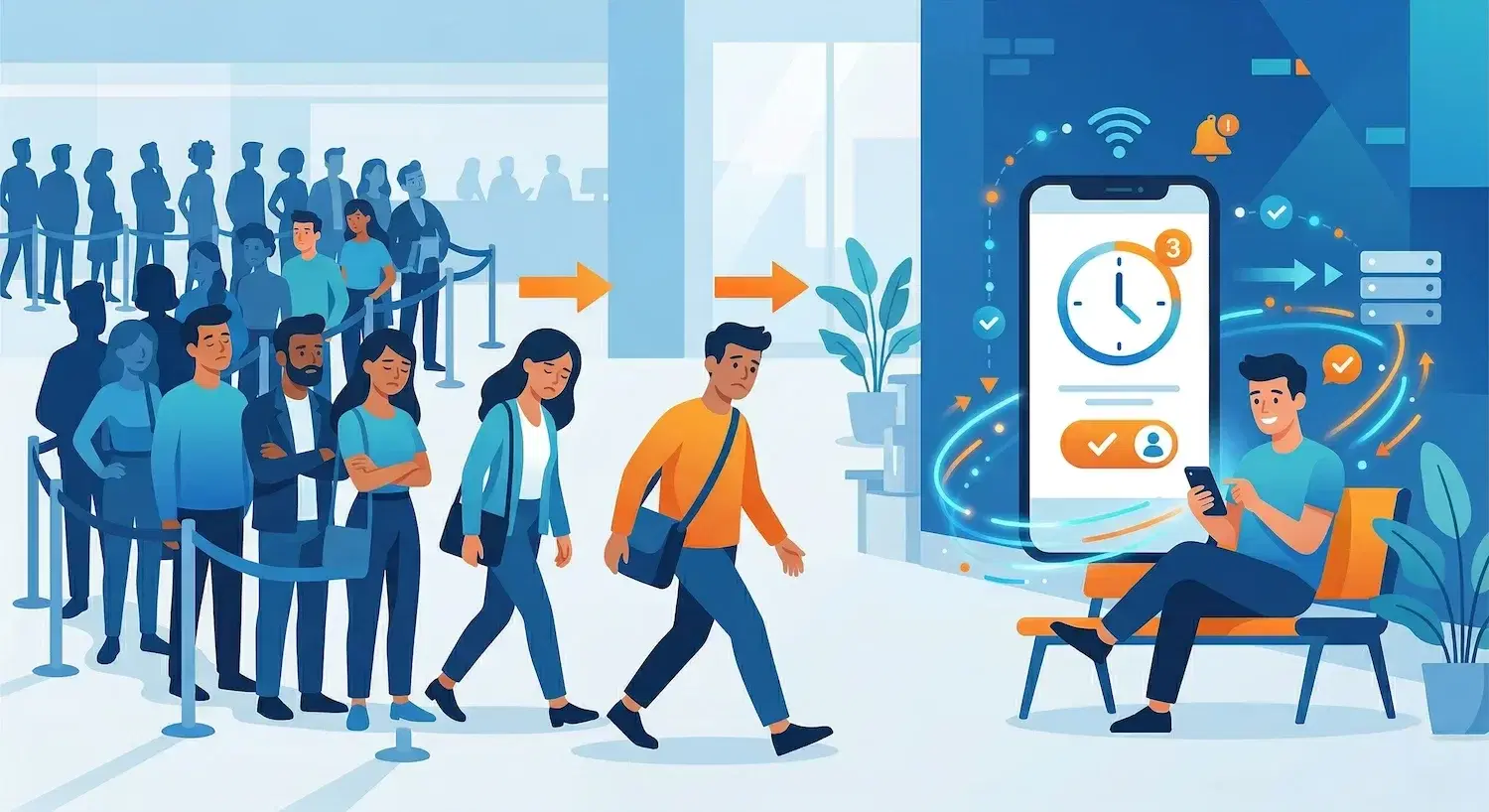
The Silent Revenue Killer: How Waiting Destroys Your Business
Picture this scenario: Sarah walks into your dental practice for her 2 PM appointment. The waiting room is packed, with no indication of delays. After checking her phone twice and watching three people still ahead of her, she quietly approaches the desk, reschedules, and leaves. You just lost a $200 cleaning appointment and potentially a long-term patient.
This scene plays out across industries every single day. Unmanaged waiting becomes a slow poison for your business operations. According to Forrester Research, 75% of consumers consider waiting time the most frustrating part of the customer experience. For small and medium businesses, every lost customer translates directly into missed revenue opportunities.
But how exactly does waiting destroy your bottom line? Here are five devastating mechanisms that turn your prospects into your competitors' customers.
1. Immediate Flight: When Customers Leave Before Being Served
Consider the fictional scenario of "Tony's Pizzeria," a 50-seat restaurant downtown. Saturday evening, 7:30 PM: every table is occupied and twelve people wait outside. Among them, a family of four assesses the situation, exchanges concerned glances, and walks to the burger joint next door where they can be seated immediately.
This immediate flight represents the first level of revenue loss. Potential customers instantly evaluate the cost-benefit ratio of waiting and choose alternatives. Research from the Journal of Service Research shows that acceptable waiting time before frustration kicks in is approximately 2 minutes in retail settings.
For small businesses, this mechanism is particularly damaging. Unlike large chains that can absorb these losses across high volumes, every customer who turns away directly impacts your results. A hair salon losing three customers daily due to waiting could mean $300 in lost daily revenue.
The solution? Provide clear waiting time information. Customers accept waiting better when they know the expected duration. This is the core principle behind virtual queue management solutions that transform uncertainty into controlled time.
2. Mid-Wait Abandonment: When Patience Evaporates
Second scenario: Jennifer arrives at her doctor's office for a 2:30 PM appointment. She sits in the waiting room on time, but 2:45, 3:00, 3:15 pass without updates. At 3:20, frustrated, she approaches reception and cancels her appointment.
This mid-wait abandonment follows a predictable curve. Harvard Business Review research indicates that customers waiting more than 5 minutes without information are twice as likely to leave. The psychological mechanism is straightforward: uncertainty amplifies frustration.
For healthcare SMEs, these abandonments create a double negative effect. First, the urgently vacated slot often cannot be refilled, generating immediate lost revenue. Second, the dissatisfied patient risks permanently switching providers.
The French Direction de la Recherche, des Études, de l'Évaluation et des Statistiques (DREES) reports that average waiting time in general practitioner offices in France is 25 minutes. In this context, informing patients about estimated waiting times becomes a major retention issue.
3. The Domino Effect: When One Unhappy Customer Drives Others Away
Third insidious mechanism: emotional contagion effect. Imagine a bakery on Saturday morning. The line grows longer, one customer loudly expresses dissatisfaction about waiting. Her frustration spreads: other customers begin sighing, checking watches, and eventually two people leave the line.
The domino effect transforms an individual problem into collective exodus. One frustrated customer becomes a "negative influencer" who contaminates the general atmosphere. For local businesses, this effect is particularly devastating as it impacts multiple customers simultaneously.
The phenomenon worsens with social media. An unhappy customer can now share their negative experience in real-time, amplifying impact beyond your physical location. An Odoxa survey for FHF reveals that 63% of patients consider waiting the main irritant in their care journey.
The remedy? Create a positive waiting experience. Rather than enduring waiting, transform it into useful or pleasant time. Informed and occupied customers spread less frustration.
4. Non-Retention: When Waiting Prevents Customer Return
Fourth impact: long-term effect on customer loyalty. Michael discovers a new restaurant, enjoys excellent food, but waited 25 minutes for a table without information. Despite meal quality, he hesitates to return and eventually chooses other venues for subsequent outings.
This mechanism is insidious because it's not immediately visible. The customer doesn't leave or complain, but simply doesn't return. For small businesses, retention represents the essence of profitability. Acquiring a new customer costs 5 to 7 times more than retaining an existing one.
Poorly managed waiting breaks this virtuous retention cycle. Even if your product or service is excellent, the overall experience includes waiting. A National Restaurant Association (US) study shows that 60% of customers choose one restaurant over another based on perceived waiting time.
The solution involves mastering the waiting experience. Transform endured waiting into chosen waiting, where customers maintain control over their time. This is exactly what a digital approach to queue management enables.
5. Average Basket Impact: When Rushing Reduces Sales
Final mechanism, more subtle: impact on average transaction value. David enters a bookstore, sees the checkout line, and decides against buying the second book he was considering. He sticks to his main purchase to "move faster."
Waiting pressure modifies purchasing behaviors. Customers stressed by queues spontaneously reduce impulse purchases. An Adyen study on physical commerce reveals that long waiting lines cause 10 to 15% cart abandonment at point of sale.
This effect particularly impacts retail stores and restaurants. Customers feeling "guilty" about making others wait behind them forgo extras, desserts, complementary purchases. Result: your revenue per transaction decreases.
To counter this effect, some businesses use virtual queues that physically free up space and allow customers to continue browsing during their wait. Customers can thus complete purchases without social pressure.
Transforming Waiting Into Competitive Advantage
Facing these five customer flight mechanisms, the solution isn't eliminating all waiting - that's often impossible. The challenge is transforming endured waiting into managed waiting.
Companies succeeding in this transformation observe concrete results. According to a Capgemini report on retail digitalization, virtual queues increase customer satisfaction by 20 to 30% on average. More importantly for your revenue: they reduce perceived waiting time by 30 to 50%.
Waiting then becomes a moment of positive anticipation rather than frustration. Customers know their status, can organize themselves, and arrive calmly for their turn. This approach particularly benefits small and medium businesses who can thus compete with large structures on customer experience.
If you'd like to discover how to implement a virtual queue management solution adapted to your business, our team can guide you through this digital transformation of your customer experience.
Sources
- Forrester Research — 75% of consumers cite waiting as main frustration
- Journal of Service Research — Acceptable waiting time before frustration (2 minutes)
- Harvard Business Review — Departure probability after 5 minutes without information
- Capgemini — Report on retail digitalization and virtual queue impact
- National Restaurant Association (US) — Restaurant selection criteria
- DREES — Average waiting time at general practitioner offices
- Odoxa survey for FHF — Patient perception of waiting
- Adyen study — Queue impact on cart abandonment
Frequently asked questions
Related articles
Hidden Cost: When Invisible Queues Kill Your Sales
Invisible waiting costs dearly: silent abandonment, damaged reputation. Discover how to identify and measure this hidden cost for your business.
8 min
Wait Psychology: Why 5 Minutes Feel Like Forever
Discover why waiting creates anxiety and how transparency transforms customer experience. Perceived time vs real time explained with data.
8 min