

Digital Queue Management for SMBs: 6 Myths Debunked
Why Do These Misconceptions Persist?
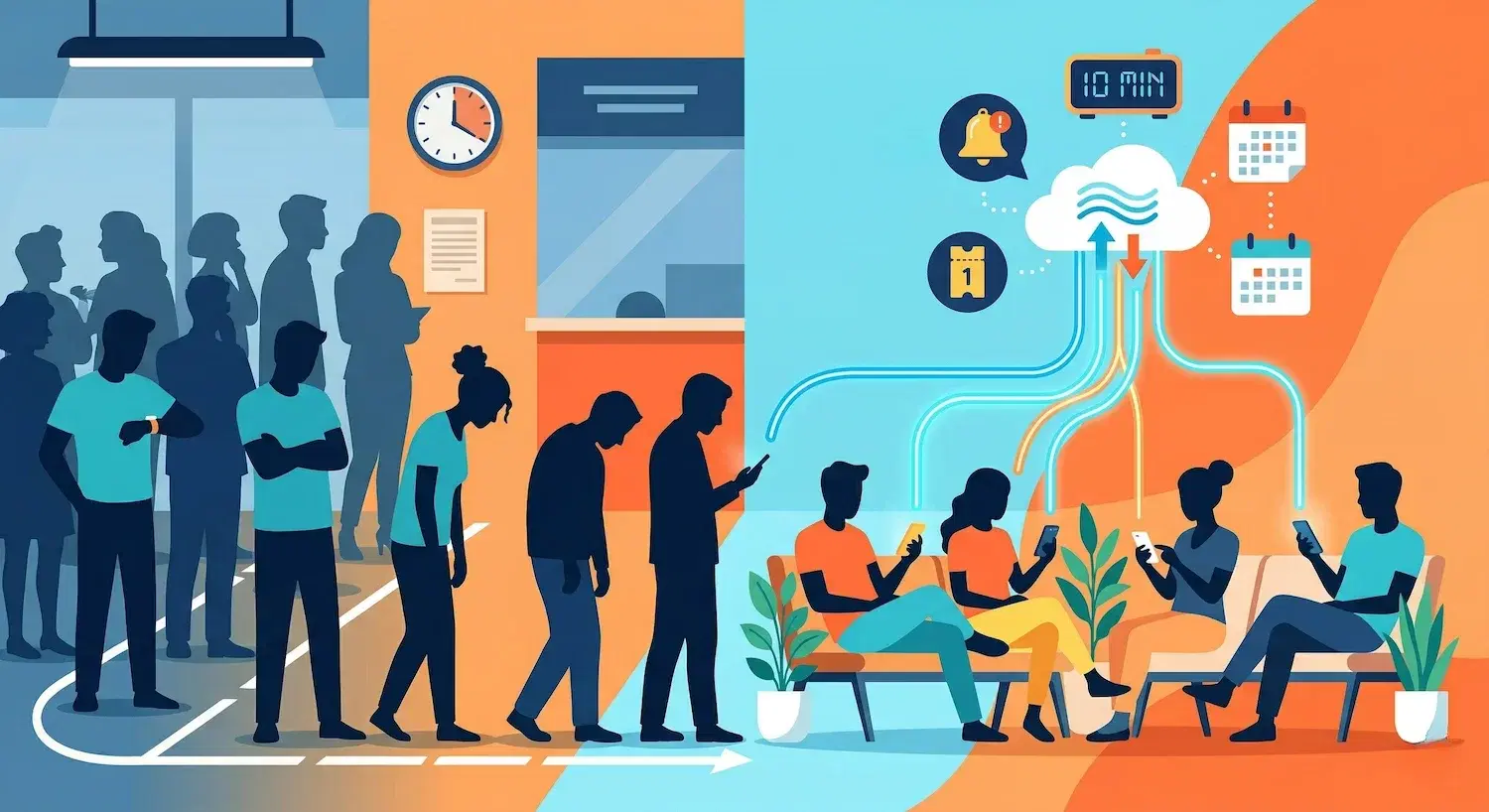
Queue digitization represents one of the last strongholds of resistance in the digital transformation of small and medium businesses. Paradoxical when you think about it — these companies have massively adopted digital cash registers, social media, and even e-commerce. But wait management? Surprisingly analog.
This resistance stems from a peculiar paradox: waiting is both the most universal experience in local commerce and the one we discuss least. A crashing website makes noise. A failing cash register too. But a dysfunctional queue? Customers simply leave in silence, without leaving any digital trace of their frustration.
What customers tell us is that this pain remains largely underestimated by small business owners. They perceive it as an inherent fatality of high traffic. This perception fuels persistent myths that slow the adoption of proven solutions in the field.
This complete guide deconstructs these misconceptions by relying on measurable facts and experience feedback we collect day-to-day. Behind each myth often lies a legitimate concern that deserves a factual response.
The digital transformation of customer experience has accelerated exponentially since 2020. Small businesses that embrace virtual queue solutions position themselves at the forefront of this evolution, transforming a traditional pain point into a competitive advantage.
Myth #1: "It's Too Complex for a Small Operation"
Myth: Virtual queue solutions require heavy technical infrastructure, advanced IT skills, and a substantial budget. Reserved for large chains that have dedicated teams.
Reality: Modern virtual queue solutions are designed on the "plug-and-play" principle. A small business can deploy a complete system in less than an hour. Without physical kiosk installation or modifications to existing infrastructure.
The functioning relies on three simple elements: a QR code displayed in the establishment, a mobile app for customers, and a web dashboard for the professional. This 100% dematerialized approach eliminates hardware maintenance costs.
No more technical breakdowns.
In practice, consider a two-practitioner medical office. Deployment? Creating an account on the platform, customizing wait messages from the web interface, printing the QR code and training the receptionist in 15 minutes. Notifications arrive automatically via mobile push and email — no manual intervention required.
This technical simplicity democratizes access to functionalities once reserved for large corporations. SaaS queue management solutions generally range between 100 and 200€ per month, an investment that often equals that of a professional phone subscription.
The scalability advantage becomes apparent during peak periods: the system automatically adjusts to demand without requiring additional hardware investment or staff training.
Myth #2: "My Customers Aren't Tech-Savvy Enough"
Myth: Small business clientele, particularly in traditional sectors or rural areas, lacks the digital skills to use a virtual queue. Elderly people, in particular, would be excluded from this type of service.
Reality: This perception massively underestimates the evolution of digital usage accelerated by the health crisis. The health pass familiarized the entire population with QR code scanning. That basically created a precedent for universal usage.
According to David Maister in his reference study, occupied waiting feels roughly 36% shorter than unoccupied waiting. This growing impatience affects all generations, including seniors. Paradoxically, they represent the most dedicated users of digital services once the initial barrier is overcome.
Modern solutions offer multiple access channels: QR code for autonomous users, or direct management by employees who register customers in the queue via the dashboard. This multi-channel approach ensures inclusion of all profiles.
User experience prioritizes simplicity: one scan, a first name, and that's it. Notifications arrive automatically on the phone, a universally mastered channel. This progressive approach allows accompanying all customers in the digital transition, even the most reluctant.
The inclusive design philosophy ensures no customer feels excluded while encouraging digital adoption at their own pace.
Myth #3: "It Will Dehumanize Customer Relations"
Myth: Digitalizing wait would create an additional barrier between the professional and their clientele, reducing human interactions and degrading the relational quality that makes local commerce strong.
Reality: Virtual queuing paradoxically frees up time for human relations by eliminating low-value interactions. Gone are the "How many people before me?" and "How much longer?" questions that pollute exchanges.
When a customer arrives relaxed because they've been informed in real-time about their position evolution via push notifications, conversation starts on better foundations. Staff can focus on advice, listening, and service personalization rather than managing wait-related stress.
Picture a neighborhood hair salon on a Tuesday evening... Clients arrive exactly at their turn, without stress or rush. The stylist can take time to discuss expectations, provide advice, and create that trust relationship that builds loyalty. The management interface allows real-time visibility of waiting customers and rhythm adjustment accordingly.
What we see at rollout is a 30-50% reduction in perceived wait time. This relaxation directly translates to improved conversation quality with customers. Technology serves humanity here, not the reverse.
The emotional intelligence aspect becomes more prominent when operational friction is removed, allowing genuine connections to flourish naturally.
Myth #4: "Return on Investment Isn't Measurable"
Myth: For small businesses, the business impact of a virtual queue remains too vague to justify investment. Unlike a direct sales tool, benefits are intangible and difficult to quantify.
Reality: The ROI of wait digitization is measured through several concrete and immediate indicators. The dashboard provides precise statistics: average wait time, traffic peaks, abandonment rates by time slot.
Consider the concrete example of a walk-in beauty salon treating about 100 clients weekly. If the establishment loses 3 clients daily due to waiting, with an average basket of $35, this represents $105 in daily lost revenue, over $3,000 monthly. Investment in a virtual queue solution pays for itself within weeks.
The bottom line is that collected data provides unprecedented visibility into activity. These insights enable schedule optimization, staff need anticipation, and offer adjustment to real demand. As shown in this Harvard Business Review study, providing pessimistic wait time estimates significantly improves customer satisfaction.
Competitive differentiation becomes measurable: enhanced loyalty, positive word-of-mouth, and innovative positioning in an often tech-poor local market. For detailed ROI calculation, check our comprehensive guide.
The analytics dashboard becomes a strategic business intelligence tool, informing decisions beyond queue management.
Myth #5: "It's a Fad That Will Pass"
Myth: Virtual queues represent a temporary trend linked to health context. Once habits return to normal, customers will prefer traditional waiting, which is more friendly and reassuring.
Reality: Virtual queue adoption is part of a structural transformation of consumer expectations that goes far beyond health context. The generation born with smartphones no longer considers passive waiting acceptable. And this requirement spreads to all generations.
Sectoral data confirms this fundamental trend. In restaurants, perceived waiting time is one of the main criteria for restaurant choice. This sensitivity will only intensify with the market arrival of consumers for whom instant is the norm.
Physical commerce is undergoing a silent transformation. Customers no longer oppose digital and physical — they demand the best of both. In this equation, waiting time has become the most sensitive variable. Not because we wait more than before, but because we tolerate less.
In our weekly calls, we regularly hear merchants tell us that their customers never go back once they've tried virtual queuing. Establishments that anticipate this evolution gain a head start. Those who wait risk experiencing silent customer erosion in favor of more agile competitors.
Virtual queuing isn't a trend, it's the natural evolution of customer journey in the mobile era.
Myth #6: "You Must Choose Between Simplicity and Features"
Myth: Simple-to-deploy solutions lack advanced features, while comprehensive tools require significant technical expertise. Small businesses must choose between ease of use and functional richness.
Reality: Modern virtual queue platforms reconcile usage simplicity and functional richness through well-designed SaaS architecture. The user interface remains intuitive while providing access to advanced functionalities.
For instance, multi-queue management allows a medical center to separately handle consultations, blood draws, and vaccinations from the same dashboard. Each service has its own virtual queue with specific parameters, without complicating the customer experience.
Event mode activates with one click to manage exceptional traffic peaks. Wait messages customize easily to reflect establishment identity. Statistics export automatically for business analysis.
That changes everything.
This "simple on surface, powerful in depth" approach allows small businesses to progressively adopt features according to their needs. They start with basic queuing and discover advanced options later. In the field, that's exactly what we observe: natural and unforced skill development.
For a virtual queue management solution adapted to small businesses, the balance between simplicity and functionality becomes a decisive competitive asset.
Frequently asked questions
Co-founder of Waitiii, leading customer success. Day to day, I support the shops, restaurants, clinics, and public services rolling out a virtual queue, and feed their observations straight into the product roadmap. The field is where you learn what actually works.
Related articles

Walk-in Barbershop: Digitizing Without Losing the Vibe
How can a walk-in barbershop digitize waiting without killing its spontaneous spirit? Real case study of a successful transformation.
6 min
Physical vs Digital Queues: 7 Decision-Making Criteria
Objective comparison between physical and digital queuing for local businesses: 7 essential criteria, real costs, and measured ROI.
8 min
Virtual Queue ROI: Complete Calculation Guide for SMBs
Learn how to calculate virtual queue ROI with a real SMB case study. Complete financial guide with concrete numbers and proven calculation method.
8 min